Wednesday, 1 February 2017

Farren Blackburn Master Class in Directing in television and film

As part of my major project I have to direct my major project when I come to film it. To understand the role better we were given a special talk from a popular television director, Farren Blackburn, who has done resent shows such as, Netflix's Daredevil and soon to come out, Marvel's Iron Fist.


He gave us in detail on how his job work in day to day life and how he became noticed and how he debt with doing his job over seas such as New York America. He described his job and the pros and cons in working within television.


  • Make Connections
Memorise names on the credits so you know wha to contact for certain information or wok opportunities.

  • Make Short Films
The more films you make  and submit to festivals, the more people you will meet and will get to know you and your work. As well as your directing style and experience with working with other people.
  • Farren Blackburn's The Fades

  • Pitch for Jobs
For directers in television, you will have to pitch the directing style and idea for filming a particular show or episode and see if you are the right director for the job. If so the studio filming the particular production will then submit a script which you will have to read and visualise how the episode will play out in your head. Writing down the ideas as much as you can will prepare you for what you would need to communicate to the filming team in order for the episode to be filmed the way you need it to be filmed. 
  • How you Visualise the series
If you have pitched for a series you haven't watched or understand, then the best option is to make sure to watch the series to get an understanding of what it antically is. What are the characters? What is the overall plot and summary of the series? If you were to approach the show how would you film the situations with those particular characters?


  • Communicate to departments
This is one for the most important aspects that a director needs to have in order to get the filming done and on schedule. Understand your idea and most of all know how to make sure the other departments understand your vision. The more your crew understands your idea, the more efficiently and understandingly they will work with you.

  • Know as much media and film disciplines as possible
The more you understand how each department works, the more better your re communicating your ideas and thought to them. Especially the camera crew department, the people who will have to shoot your vision and make it come to life the way you want it.
  • Look for potential in the material 
If the script is nothing special to you then turn it down, if you are starting out then you might want to conceder it anyway just for the experience. Remember you can turn a bad idea into an entertaining film or television series episode. If the script has potential then have the same confidence to apply for it and work on your visional on how to film it and make it even better.
  • Scripts often come late (Don't over develop them)
An over developed script can often be donating and confusing and would require much conversations with the head writer so you know what the martial contains and requires of you.  If parts of the script you are working on does not turn up on time then prep yourself as much as you can before it is finally handed in for you. The more prepared you are, the more adjusted you are for the new script.
  • When talking to writers with big egos, ask questions, don't criticise 
So writers think that each idea they come up with are pure gold, Farren even mentioned Steven Moffet for one of them, the head writer of Doctor Who. The way to get comfortable with a writer is to make sure you are one their good side and try to ask questions on materiel you don't understand. The more you understand the writer's idea the more easier it is to ensure that you can work with it. You can even ask if an idea that you had can work with their script, even if they say no try your best to make their ideas even better for when it is prepared to be aired on television.
  • Remember K.I.S.S (Keep, It, Simple, Stupid)
The more overly complicated the idea, the more stressed and tired you become, don't over think things. Get to the point of the idea and make sure everyone on your team understands what is required of them at certain points of the production.
  • Think about what you have to keep the story forward
If you are at a still point of the production and have nothing to go on, think back to what you have already done and look at the martial you have. Is it enough? Could you do more takes of a certain shot? Look at the resources you have and work with them as much as you can before a day of filming is thought, you might get more coverage of shots that could prove useful to the editor when he or she is working on putting the finished project together.


YOUR DIRECTOR'S VOICE:
Your voice is always there, it will come in time. You are a story teller, even if you don't have a specific voice, tell the story the way you visualise it and how it is written.


Working with actors:

When chatting with actors:
- Understand the story
- Understand the Characters
- Understand and watch the series

  • Have good people skills, relationships and understandings

  • Work with their egos


Notes to take when casting:
- Do you like this person?
- Are you going to get on well?
- What does the story require from this actor?
- Be flexible 


Things to consider:
  • Try to make each project have it's own tone

  • Put in as much time before the day is done

  • Remember the story is always important

  • communicate the ideas with as many people as possible, with confidence.

  • The tiniest thing can change a film or show


American television is different:
- Often under prepped 
- People are usually late
- Ideas can change


Lastly:

Don't compare yourself to other people!

Film Makers die on set (it is not a retiring job) 

The first step on set is always the hardest

Remember to eat and sleep and don't get over stressed!


I have learned so much from Farren and was glad to get the opportunity to hear his voice and understand what he has been through to get where his is today. He has worked hard and often with people hard to work with as well. He has persevered and now working on a fantastic upcoming show, Marvel's Defenders which I just can't wait for .

He has inspired the whole course to believe in themselves and to go forth and achieve their dreams in any way possible, he said that we can do it and had faith in us as people. He not only delivered what we needed to hear but what we want to hear. In most lectures some of the tutors keep on explaining that the the real world is tough and a living hell and often leaves us with fear in our hearts. Farren however kept giving us the main point of what he was saying and made the real world less scary because of his experience, it felt like we were completely with him on his journey throughout the industry. We left the studio with visions of a brighter future and the confidence we needed to achieve success. I can not thank him enough, he was an amazing person in real life and I hope to see more of his amazing work in the future.


Tuesday, 31 January 2017

Major Project - Location (Community Centre Scene)

Hempstead Library


What makes this location special is that not only is it local to me but also their facility is acquirable for free. There is a backroom to the library that I can decorate to look like a Jehovah's Witness meeting inside a community centre.


With clever camera shots and angles I can create a the scene between the main character Henry and his farther whose head will not be seen throughout the entire scene. I will have to make sure that there is enough space for the actors and crew from when the filming will take place. 


The main issue is to make sure that the furniture the library has provided look right for the scene, and how many chairs they have on set. If it has no right feel or look to it then I will have to find somewhere else to film.


Sunday, 22 January 2017

Major Project - Table Read 22/01/2017

My first table read with 3 of my main actors 2 of my producers and 2 of my production assistants. The purpose of the table read session was to get the best out of my actors and crew for understanding the whole script.

I wanted to make sure the actors where fully committed to their characters and understood what I wanted from them as they play their characters the way I envisioned.

Since two of my other main actors couldn't make it my producers and production assistants helped out filling the rest of the other roles provided in the script.

Full video:


For the rest of the meeting I decided to catch up on dates my actors were free to film as well as go over some of the prop and costume designs for some of the characters. I made lists of all the clothes and items the actors would need and most of which my actors had already acquired to their roles in my film.


What was even more helpful was that I got advice from my producers about what they thought of the script and how in n some aspects we could improve it. Plamen even told about the different lenses that we had acquired to help with filming different scenes in terms of width and focus of the shots. For some of the outside shots with the scene of henry walking throughout Rochester the wide angle lenses would help getting the most out of the location as well as full body shots of the main character Henry.

There was a lot to contribute to the film and a lot of bonding shout with actors and crew, everyone got along perfectly and enjoyed the script read though and feedback was appreciated and taken note on how much I could improve on the film in order to make it as professional as it can possibly be.


Thursday, 12 January 2017

Major Project - Script Breakdown

Locations:

  • Rochester High Street 
  • Delinquents House Maidstone
  • Community Centre
  • My House


Props:


  • Watchtower Magazine
  • Art Canvas
  • Canvas Stand
  • Black and Red Paint
  • Black Bags
  • Food Wrappers
  • Spare underwear 
  • Beer Bottles
  • Electric Guitar
  • Amp
  • Games Console (ps2)
  • Controllers
  • Empty drink cans
  • Teddy Bear
  • Lots of Books
  • Safety Mat (?)
  • Poster for Agnus (ask Kaye to Design one)
  • Flour (White)
  • Banana peal


Problems to think about:


  • When making the poster that Agnus is working one, ask concept artist to design one for the film.
  • When it comes to the scene with Kevin and Robert, someone or a safety mat will have to be put into place so that Robert (when blown away by Kevin's guitar) will land safely into the kitchen without cause of harm or injury.
  • Since most of the scenes take place in the evening I must keep track of time or find a way to block out most of the natural light to make it more like the evening. The scene with Henry and Agnus in the basement can be recorded in the morning and the rest can be done at a later time since most of other shots consist of natural light in the evening.
  • When it comes to the scenes with the two young boys in the flashback, it might be wise to have it filmed at my house so it is easier to set up and the rest of the shots can be done in one day.
  • Make another day of working on the room scene with Kevin, Agnus, and Henry as it is set in a different location.
  • Make sure to get as many different shoot and coverage as possible, especially when it comes to the title sequence.
  • Also make sure to get lots of coverage of houses and doors being slammed  for the Rochester High Street scene.
  • To make the lightning effect, make sure red lights are set up outside and ready to be switched on and off to pull of the effect.
  • Make sure food is always provided on the way to feed actors when it comes to scheduling.
  • If actors are coming by train have Alex ready on stand by to pick them up from their destination. (Maidstone East?)

Friday, 16 December 2016

Critical Reflection

What Worked?
Creating the book was a simple process, using the website 'BLURB' I was able to find a quick book template and insert text and pictures easily and proficiently. When it came to the final print out of the book, the pages and front cover were done by the people at 'The Printers' in Chatham who kindly professionally printed out my book and wire blinded it, all ready in 5 mins, ready for my submission.


The story and structure took a while to shape out but as soon as I got my story idea, the plot and characters soon became to shape out. It was simply taking my title and reconstructing the idea into something different but had the same edge.

Finding the right actors was a simple process as most of the character roles I visualised already had people in mind. John Redding for example was planned from the beginning to be a major part of the production and he kept at the chance to work with me again.

Other actors were found by mere coincidence such as Natalie Bradbury who worked at my part time job at PQA in Tunbridge.

Most of the researching process on a specific religion was a challenge yet interesting to ravel into. I found out so much at the Jehovah's Witness religion, some facts even scared me a little. What made it fun was imputing these facts into the script and story.

My concept artist was amazing to work with and she delivered what I wanted, when I wanted it. Her work was up to professional standards and I was happy what she came up with and the style in which she constructed it.


What didn't work?
My original idea of having a failing psychology student to rehabilitate a bunch of messed up young delinquents was way to complicated to make into a short film. The plot was far to complicated for some people to understand, some of the ideal locations I wanted were far too big and too expensive to hire and design.

Working by myself was a challenge, I needed to communicate with my peers and team up with someone in order to get more work done. I found myself over stressed and tired because of the amount of work required and I found it a struggle.

I let to let the original idea go, in doing so I had to come up with another as soon as possible and pitch it to my tutor. At lot of the time it was time wasting in finding my new story and finding a new angle of tackling my characters.

Since I was partnered up with 2 other uni mates who were also making films, we had to organise our thoughts and find a way to work together in order to make our films work and most of all achievable. Because we had to spend most of the time thinking hypothetically, we wasted to much time on showing action plans, and pointless updates on our blogs instead of showing how we were going to share resources and make our films work and achievable so we can in the end, 3 short yet detailed films all ready to submit for our final major project by the end of the third year.

There were a couple of issues when it came to printing out my book for submission. 'BLURB' needed me to first upload my book and then requested that I had to pay for a PDF file to be sent to me. The only problem was that the file has less quality then I thought as the company want to professionally print out a hard copy of the book which would have cost me over £100 and I would had to have wasted over 2 weeks in order to receive it. with the time that I had I went with the PDF file as that was all I could do.

What did I learn?


  • I have learned the value for organisation and working with other people. 3 films are hard to work around and even harder to predict as well as plan around them to see if each of them can be filmed and achieved.
  • Research is essential, when it came to researching the Jehovah's Witness region, I needed to make sure that each fact about their religion was accurate and true. 
  • Use time wisely, most of the time my team were too focused into proving to our tutor that our films can be achieved that half the time we could have just gotten to the point and continued with our pre production.
  • The amount of detail required is necessary, the director's statement was a long process as I needed to make sure I had my vision explained and understood in paper form which is often my week point. I have learned that the more detail you have the better, even though I feel that I could have added a lot more detail.
  • I have learned that I don't have to necessary do the work all on my own, there were professionals I could have hire like a production designer. Since I was by myself I found that all of the work was often too much for me to handle and often found myself staying up till 2am or 4am to make sure certain aspects of my work was done.


What could I develop?

  • I could develop my communication skills when working in a team. I was so focused on my work most of the time I needed to keep up with my team to work with them and get to the point of were we knew what we could share in order for our films to be achieved.
  • My research, I feel that I need to amp up my research into my pre production. My director's statement needed so much detail that I feel I could have added a lot more content. I couldn't even find or get a production designer to help with the design of the film.
  • My confidence, the first presentation I pitched was terrible and I could have said and explained things a lot more detailed and simpler.

Pre Production Unit - Crew Updated


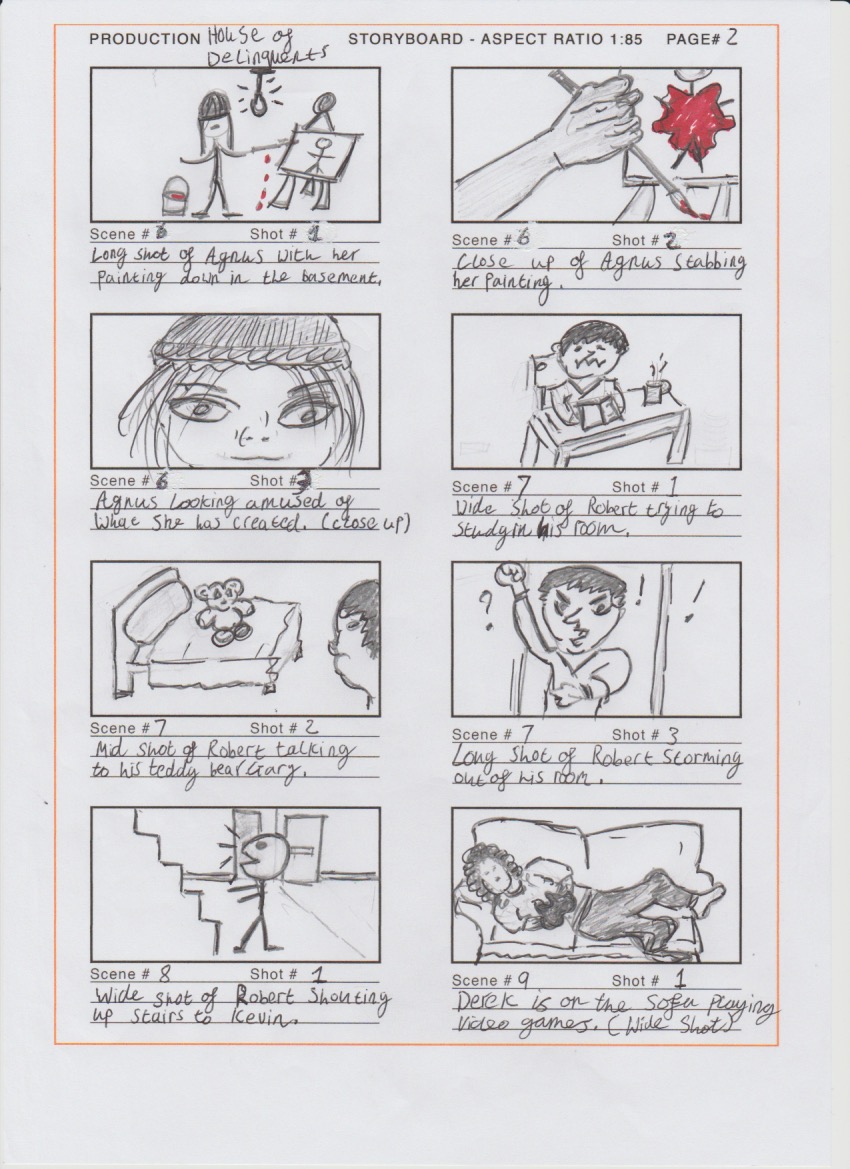
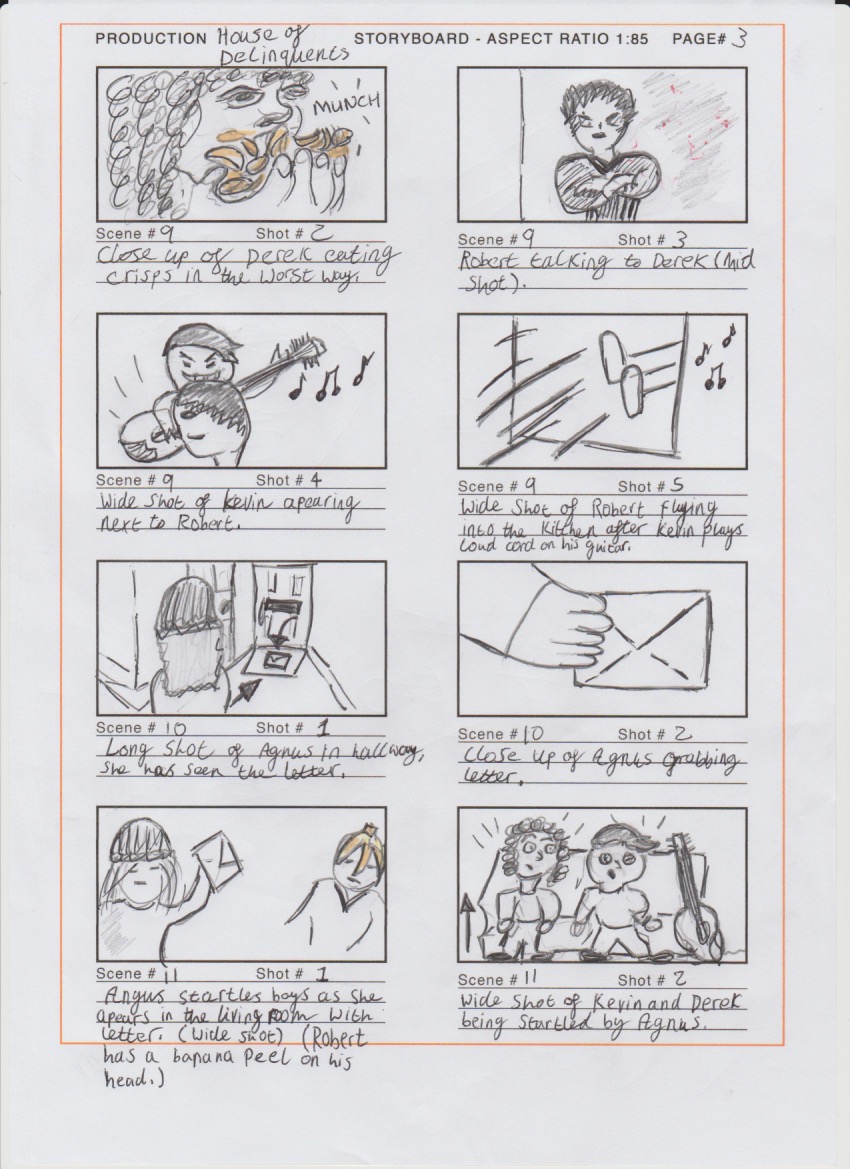
Storyboard and Shot Lists


Storyboards:


Shot Lists: